Source of Image: http://www.kingwealth.com/
 
こんにちは みなさん!
(Konnichiwa Minasan!) 


Have you ever woken up one day from bed, and realized that we are actually living in a place that is full of media penetration?!


It's true. Listed from old medias such as books, newspapers, and radio to new medias such as television, smartphones, and tablets along with internet accesses, our life is basically infiltrated with information and technology. However, with the emergence and spread of ICT since the mid-1990s, it has become a worrisome matter lingering around in the mind of policy makers and social scientists as a new phenomenon occurs, namely "digital divide". Digital divide, according to OECD (2001, p. 5), means 


http://www.powerfulinformation.org/ 


...the gap between individuals, households, businesses and geographic areas at different socio-economic levels with regard both to their opportunities to access ICTs and to their use of the Internet for a wide variety of activities.


However, the working paper by Paul DiMaggio and Eszter Hargittai (2001) proposed a different opinion as they noted that there has been a change of trend among researchers such as scholars like Benton, Hoffman and Novak focus on ICTs have moved from its unequal distribution among individuals and societies to inequalities among the ICTs consumption of people; investigating inequalities in terms of their ethnicity, education level, income and other resources. In turn, the digital divides of "haves" and "have-nots" have been reduced to the differing degrees of internet access availability for each individual. 


Source of Image: https://cio.gov/

Therefore, we have conducted a similar survey to investigate the ownership of new media and online media consumption pattern. A simple questionnaire consisting of 30 questions have been designed using the Google form (click to access our questionnaire). The questionnaires were distributed to 20 respondents within an age range of 20 to 25 years old. These respondents were selected as they are the generation of youth that has been tagged with the labels of "Net-generation" and "The Millennium Generation" or at times, even regarded as "digital natives" which indicates that they have established a firm relationship with technological gadgets and would provide much better understandings on the various technology consumption (Prensky as cited in Mesch, 2009).

And drum rolls please, as our mini research revealed that all of our respondents are all "haves", that is they are the proud owners of at least one new media. Moreover, the sole digital divide that we thought to have existed between students living in university campus and students living outside campus was also non-existent as while students on campus have a better chance to surf the internet using the university-provided WiFi, all 60% of respondents living outside campus are also reported having some form of internet connection such as mobile data or broadband.   

Henceforth, we diverted our attention from "digital divides" to "digital inequality" focusing on technical means and use patterns. But, digital inequality, in general, can be described in 5 dimensions which include the autonomy of Internet use, technical means (hardware and connections), skills, social support and the purposes people use technology as proposed by DiMaggio and Hargittai (2001).


A consequence of modernization, digital gadgets have become the most important accessory for many, especially the youth. From our simple survey, all respondents are owners of smartphone and laptop/netbook while  two of them reported having another regular phone and a mp3 player respectively. Once again, these results show that there is no digital divide among the students as the youth nowadays, especially the students ownership of new media is not limited to one. But, there is an inequality present as 30% reported using Apple brand which is slightly more expensive than other brands of Asus or Sony with its minimum purchase being >RM1000.
For a clearer picture, you can refer to the two diagrams above which displays inequality in terms of 2 technical means: (1) the brands of the gadgets and (2) their spending on Internet connection per month. What should be highlighted is that all of the respondents despite having access to WiFi in the university campus still spend money on internet connection, with 15% reporting monthly spending of RM 90-RM 120.


Another digital inequality that cuts across the youth nowadays in the case of Internet access is the consumption pattern of the internet. This inequality can be observed in terms of gender as shown in the table above. Highlighting the odd and the weird, did you guys noticed that there is not much difference between the male and female use of the internet as an overall but there is a significant difference in terms of using the internet to search academic materials. Is this somehow closely related to the issue why more females are in higher education compare to males?

Anyway, another trend among the various uses of the Internet is the use of internet access for social media which charted highest, disregarding gender. Thus, our respondents are more likely to use it  as a form of communication technology for as much as 80% of them interact with their families and friends through the internet. This is perhaps due to the respondents being away from their home and need to keep in contact and connected with their family and friends, and what could be more convenient and cheaper than the free WhatsApp call or WeChat text. Thus, overall, the Internet consumption pattern among studying the 20 respondents conclude to be primarily communication and networking.


Social media is a new form of communication product which has converted the way people communicate (Cabral, 2010). And this trend is also shown among our respondents as well but through different channels. In the illustration chart above, it is obvious that Facebook and WhatsApp are the most popular social media that young people used nowadays. Thus, new media have increased the social interaction among the different society around the world and this has changed many perspectives, values, and socio-cultural aspects that have been reaccessed (Chen, 2012). 


NO-MOBOPHOBIA

As a conclusion, among the university students in Malaysia, there is relativity more digital inequality compare to the digital divide. And as a bonus, we reveal the results of a Nomophobia which have been included in our questionnaire as well, accessing the attachment of the respondents to their phone. 

Nomophobia is short for "no-mobile-phone-phobia" which as its name suggest is a fear of being without a mobile phone, though some suggest that the use of phobia is an exaggeration of what is an anxiety. Nevertheless, with Internet access growing as an important resource, many have grown attached to their phones and some to the extent of developing a new "disease". This disease is said to cut across age, gender, ethnicity and nationality with symptoms of bringing in mobile devices into bathrooms, the habit of constantly keeping phone battery fully-charged and obsessively checking phones for missed calls, emails, and texts. This checklist presented to our respondents however only yielded a 9:11 ratio with nomophobes  being the majority. And that concludes this episode of new media consumption.


Source of image: http://www.pakwheels.com/


If you are interested in checking out if you are a nomophobe or not, here is a the self-assessment checklist we used. Do try it out and leave comments below. 


References 


Cabral, J. (2010). Is generation Y addicted to social media? Retrieved from:

Chen, G. M. (2012). The impact of new media on intercultural communication in global 

           context. Retrieved from http://digitalcommons.uri.edu/cgi/viewcontent.cgi? 
           article=1012&context=com_facpubs 

DiMaggio, P., & Hargittai, E., (2001). From the 'digital divide' to 'digital inequality': 

           Studying internet use as penetration increases. Retrieved 
           from https://www.princeton.edu/~artspol/workpap/WP15%20-  
           %20DiMaggio%2BHargittai.pdf 

Mesch, G. S. (2009). The internet and youth culture. The hedgehog review, 11(1), 50-60. 

           Retrieved from http://www.iasc-culture.org/THR/archives/YouthCulture/Mesch.pdf 

Organisation For Economic Co-Operation and Development (OECD) (2001). 

          Understanding the digital divide. Retrieved 
          from https://www.oecd.org/sti/1888451.pdf 
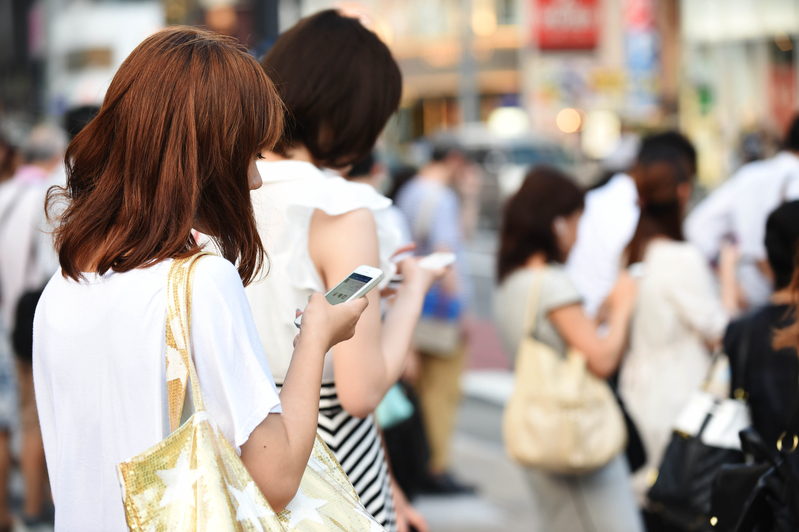
Source of Image: http://img.epochtimes.com/


G'day, peeps!


Throughout the years, the many different means used to communicate with others, for example, letter-writing, telegram, telephone and even face-to-face speaking has added and welcomed yet another new member to their family which is computer-mediated communication (CMC). Continuing the discussion of CMC previously posted, this post will focus on a different capital C which stands for culture, focusing on the causal effects of CMC on our culture.


It is needless to say, with the recent phenomenon that, CMC have caused a cultural shift in our many lifestyles and habits. The times of awkward moments when we have to confront someone face-to-face to get our message along can now be substituted by computer-mediated communication. Confessing to your crush with a written love letter tucked in their shoe locker is now a thing of the past or found in movies. Dear John or Dear Jane letters (a.k.a breakup letters) are now written in WhatsApp, WeChat, and Line with the new generation of phubbers. (p.s. 'Phubber' is a term newly created from combining the two words 'phone' & 'snubber' which describes the type of people who have their face planted on their phone, above everything with the intention of ignoring their 3D surrounding).

Lack of Social Context Cues

Social sciences since the beginning of CMC have always been interested in its causal effect, especially the impact of CMC on culture. One of the electronic media theories explaining the difference between CMC and face-to-face communications, according to Griffin (2009),  is the lack of social context cues. Griffin explains that this theory claims that CMC users have become more self-centered and less restricted as they do not have an anchor to their relative status and there are no clear social guidelines regarding the norms for interaction. This is a similar perspective to the social presence theory as it argues that it is without social context cues that participants are deindividuated and thus behave in the way that they will derive from normative behavior (Thurlow, Lengel & Tomic, 2004). 

http://www.symbols-n-emoticons.com/
According to Walther (2006), there are two consequential behaviors which say that, 

these states lead not only to colder and more task-oriented communication, but also to engage in flaming (name-calling, swearing or other uninhibited expressions) online and more attitude polarization (p. 259). 

It is precisely because of this absent in social context cues, social inhibitors are reduced and behaviors subsequently becomes more uninhibited which thus caused people to display less socially desirable behavior. The thing is people just simply become less concerned with others which reduce the needs to be liked and accepted by others, potentially creating conflicts such as the Merry EX-Mas case down below...

Merry EX-Mas

Once upon a time, on a snowy Christmas day, a man named Tom created a WhatsApp group, adding in Lisa, Gemma, Steph and Bella. He called the group Marry EX-mas, which as you can guess, turns out to be a group with his ex-girlfriends. For starters, can you imagine being in one room with all your EXes and surviving it? Well, maybe we couldn't in the past but now that there is a chat room, a man did. As we quote, his aim was for his exes to "...share some memories of me with each other as I am lonely this year and miss the lot of ya". But, as things go, the conversation turns out to be chaotic. If you are interested in the whole story, you can check out more about this little tidbit via Mirror News.

Thus, it is evident that our culture has indeed changed with the introduction of CMC with tweeting, snap-chatting, #selfie etc., which has all made us more connected to each other. But, at the same time, has it made us more distant as to not care about our impression on others or has it made us more truthful in our expressions? Yet, take to heart that being real and being mean are two different things. Lastly, we hope you can


Source of Image: https://media.licdn.com/

And that's the end! We hoped you enjoy reading about CMC. But before you disconnect, a question for your thoughts, 


"Is CMC making us real or making us mean?" 

Feel free to comment below.

References

Griffin, E. M. (2009). A first look at communication theory (7th ed.). NY: McGraw Hill 
          Companies, Inc.

Thurlow, C. Lengel, L., & Tomic, A. (2004). Computer-mediated communication: Social    
          interaction and the internet. London: Sage.

Walther, J. B. (2006). Nonverbal dynamics in computer-mediated communication, or :( 
          and the :('s with you, :) and you :). In V. Manusov & M. L. Patterson (Eds.), The Sage   
         Handbook of Nonverbal Communication (pp. 255-282). CA: The Sage Publications.
Source of image:http://www.engadget.com/

Hola, peeps!

Our very first blog today is going to be a discussion about CMC. 

 The question, first and foremost is:

'Do you know what the acronym CMC stands for?'

Any guesses as to what it means?
Call me, maybe? Hold on, that's CMM 
Or maybe the googled 'Chemistry, Manufacturing and Control?'. 

But, still that is not tech-related.

On a second note, it's funny how the tech-related CMC is not the immediate answer on the list of CMC googled acronyms. For though it might not have the fame of LOL or YOLO but CMC is a 'thing' that almost everyone is or has been engaged in. 


'Computer-mediated Communication', that is the answer, term, and act that has dated for almost half a century as its origin is traced back to the 1970s with Hafner and Lyon referencing the first email sent in 1972 between two networked computers (as cited in Herring, 2010). Synonymous to CMC would be the more familiar WhatsApp, Wechat or Facebook, which are in actual fact examples of CMC. But, that is not all CMC is, for according to Gerry Santoro (cited in Thurlow, Lengel & Tomic, 2004), CMC in its extreme even includes the diverse applications of statistical analysis programs, remote-sensing systems, and financial modeling programs. 

In spite of that, our emphasis on CMC is closer to the definition provided by December (1997), which is
“A process of human communication via computers, involving people situated in particular contexts, engaging in processes to shape media for a variety of purposes”.
or as Yu (2011) puts it, a system which is both human and computer, something that is alive instead of being some rigid facility. Though in our opinion – simplified – CMC is basically human-to-human communication through a screen. 


In fact, you simply being here and reading this blog (bienvenue or welcome by the wayis a good example that CMC has changed many of our communication habits, 

Source of image: quickmeme.com
we 'text' instead of speaking, 
we 'email' instead of writing letters  
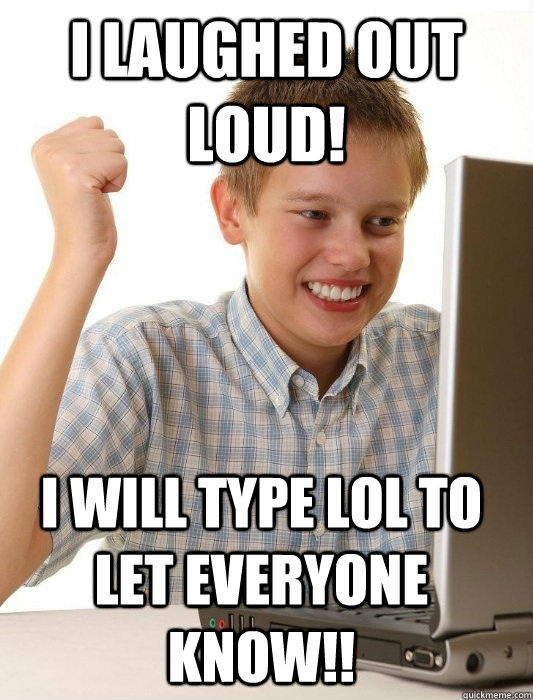
and we 'LOL' instead of really laughing out loud.


But there is 'less' to CMC than what meets the eye, as many scholars viewed CMC to be only at best - a metaphorical mode of 'conversation' but not a literal description of it; since it is not anything like face-to-face communication (Herring, 2010). Early researchers of CMC (Kiesler, 1986; Kiesler, Siegel & McGuire, 1984) states that CMC lacks in the department of social presence and media richness as there are limited cues of physical presence and nonverbal gestures compared to the traditional mode of communication which is face-to-face, spoken and heard straight on. Despite so, Herring (2010) states that CMC's users often refer to CMC activities as conversations, using verbs such as 'talked, said and heard' instead of 'typed, wrote or read'. And the truth is, our social interaction has enabled us to connect with people in the way we never could in our past history and CMC has indeed redefined our communication and enriched our experiences.

A Personal Experience(s)

Source of Image: http://titan.calm.unimas.my/
Engaging in asynchronous communication daily has been a habit of mine since entering UNIMAS, as I obtain lecture slides, PDF reading materials, useful links and announcements through Morpheus. I think that this way of information delivering system is much more convenient compared to manually jotting down notes. Besides that, Morpheus illustrated an example of consistent interaction between lecturers and students, as it pose as another channel of media apart from depending solely on the limited lecture time of two to three hours.


Source of image: http://d11sjosxu0rtpd.cloudfront.net/
I, for once don't think it's embarrassing to admit that you're homesick but still being busy and all, I have never really realized or spelled-it-out. But, it's only until when I have received a Skype call from my grandmama in Seremban as she tested her newly set-up Wifi, that I realized how much I have missed her. And it's not something a phone call can compare... watching and listening to her. It conveyed just as much information and presence, just as if we are face-to-face though separated geographically. A synchronous call, though not face-to-face, is really the next BEST thing.   
At last, CMC does not only asserts influence on our modes of communication with each other but its influence and impact extend into our daily lives... 

Tune in next time to read our new post 'CMC - a Cultural Hack'. 

References

December, J. (1997). Notes on defining of computer-mediated communication. Computer
Mediated Communication Magazine [On-line], 4(1). Retrieved from http://www.december.com/cmc/mag/1997/jan/december.html

Herring, S. C. (2010). Computer-mediated conversation: Introduction and
overview. Language@Internet, 7(2).  Retrieved from: 
              http://www.languageatinternet.org/articles/2011/Herring

Kiesler, S. (1986). The hidden messages in computer networks. Harvard Business Review,
64(3), 46-60.

Kiesler, S., Siegel, J., & McGuire, T. W. (1984). Social psychological aspects of computer- 
            mediated communication. American Psychologist, 39(10), 1123-1134.

Thurlow, C., Lengel, L., & Tomic, A. (2004). Computer-mediated communication: Social
interaction and the Internet.UK: London, SAGE.

Yu, B. (2011). Computer-mediated communication systems. TripleC, 9(2), 531-534.


Source of Image: Bestcoverpix.com

Hello, peeps!

We are 'tidbits' and we are newborns to this world of blogging.

Our blog is going to be about technologies of human communication and the like.

Do stay tune for more posts!

Happy reading and remember to comment ;)